Showing posts with label travel. Show all posts

Sunday, August 19, 2007

Phong Nha - Ke Bang

Phong Nha - Ke Bang is a national park and UNESCO World Heritage Site in the center of Quang Binh province in north-central Vietnam. It protects one of the world's two largest Karst regions with several hundred caves and grottoes.
Location
Phong Nha - Ke Bang National Park is located in the Bo Trach and Minh Hoa districts in the center of Quang Binh province. The park is bordered by Laos in the west. The road distances are about 500 km south of the capital Hanoi and 260 km north of the port city of Da Nang. The geographical coordinates are 17°32′14″N, 106°9′4.5″E.

Park layout
The park covers a total area of 857.54 km² which are divided into three zones, a "strictly protected zone" (648.94 km²), an "ecological recovery zone" (174.49 km²), and an "administrative service zone" (34.11 km²).

Recognition by the UNESCO
Phong Nha-Ke Bang national park was first nominated as a UNESCO World Heritage Site in 1998. It was recognised as a world natural heritage site at the UNESCO's 27th general assembly session being held in Paris from June 30-July 5 2003. At the session, delegates from over 160 member countries of UNESCO World Heritage Convention agreed to include Phong Nha-Ke Bang park and 30 others worldwide to the list of world heritage sites.

Geological significance
Phong Nha-Ke Bang national park is one of the world's two largest limestone regions. In comparison with 41 other world heritage sites which have karsts, Phong Nha has dissimilar geomorphic, geologic and biotic conditions. The karsts of Phong Nha can be traced back to Palaeozoic 400 million years ago. This makes Phong Nha is the oldest major karst in Asia. If the Hin Namno, bording Phong Nha on the west (in Laotian territory) was to be combined with the National park in a continuous reserve, the combined reserve would be the largest surviving karst forest in South-east Asia (317,754 ha).
The area has numerous grottoes and caves. Vietnamese and British scientists have so far surveyed a total of 20 caves with a total length of 70 km. Of these surveyed caves, 17 were in the Phong Nha area and three in the Ke Bang area.
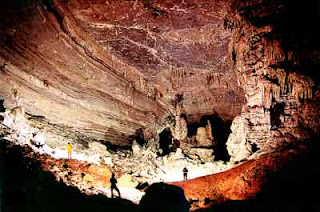
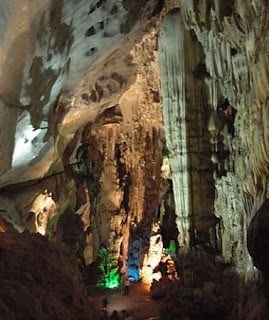
The Phong Nha cave from which the name to the whole system and the park is derived is famous for its rock formation which have been given names such as the "Lion", the "Fairy Caves", the "Royal Court", and the "Buddha".
Besides the grotto and cave systems, Phong Nha has the longest underground river, the largest caverns and passageways. Phong Nha - Ke Bang also contains two dozens of mountain peaks with over 1,000 metres height. Noteworthy peaks are the Peak Co Rilata with ta height of 1,128 m and the Peak Co Preu with a height of 1,213 m.

Diversity in ecological system
The park is part of the Annamites eco-region. According to the results of initial surveys, the primary tropical forest in Phong Nha - Ke Bang 140 families, 427 genera, and 751 species of vascular plants, of which 36 species are endangered and listed in the Vietnam Red Book. The forest is also home to 98 families, 256 genera and 381 species of vertebrates. Sixty-six animal species are listed in the Vietnam Red Book and 23 other species in the World Red Book.
In 2005, a new species of gecko was discovered here by a group of Vietnamese biologists together with biologists working for the park, Cologne Zoo in Germany and the Saint Petersburg Wild Zoology Institute in Russia.
Historical significance
In addition to the diversity in the ecosystem, Phong Nha - Ke Bang is home to archeological and historical relics, such as an ancient hieroglyphic script of the Cham ethnic minority, King Ham Nghi's base built for the resistance war against French colonialists in the late 19th century, and the Xuan Son ferry station, Ho Chi Minh Trail and Road 20 used during the Vietnam War.

Tourism development in recent years
Central Quang Binh province has invested into upgrading the Phong Nha-Ke Bang visitor site to turn it into the country's major tourist destination.
Multiple eco-tourist projects have been licensed for development and the area is being heavily invested by the province to turn it into a major tourist site in Vietnam. Phong Nha Ke Bang is part of a tourism promotion program called: "Middle World Heritage Road" which includes the ancient capital of Hue, the Champa relics of My Son, the city of Hoi An, and the space of Gong culture in the Central Highlands of Vietnam.
In order to facilitate the increasing flow of tourists to the site, the Dong Hoi Airport was constructed

En.wikipedia.com

Thursday, August 16, 2007

Ha Long Bay - the most beautiful bay of the world

The legend of Ha Long has it that, “Once upon a time, soon after the Viet people established their country, invaders came. The Jade Emperor sent Mother Dragon and her Child Dragons down to earth to help the Viet people fight against their enemy. Right at the time invaders’ boats were rushing to the shore, the dragons landed down on earth. The dragons immediately sent out from their mouths a lot of pearls, which then turned into thousands of stone islands emerging in the sea like great walls challenging the invaders’ boats. The fast boats couldn’t manage to stop and crashed into the islands and into each other and broke into pieces.
After the victory, Mother Dragon and Child Dragons didn’t return Heaven but stayed on earth at the place where the battle had occurred. The location Mother Dragon landed is nowadays Ha Long Bay and where Child Dragons descended is now Bai Tu Long. The dragons’ tails waving the water created Long Vi (present Tra Co peninsula) and formed a fine sand beach over ten kilometers long”.


Ha Long Bay is located in the northeastern part of Vietnam and constitutes part of the western bank of Bac Bo Gulf, including the sea area of Ha Long City and Cam Pha Town and part of Vân Đon island district. It abuts Cát Bà Island in the southwest. Toward the west is the shore with a 120 km-long coastline. It is located within 106o58’-107o22’ east longitude and within 20o45’- 20o50’ north latitude. The site is 1553 sq. km with 1969 islands of various sizes, of which 989 have been named.The islands in Ha Long Bay are mainly limestone and schist islands most lying in the two main areas: the southeastern part of Bai Tu Long Bay and southwestern part of Ha Long Bay. These islands represent the most ancient images of a geographical site having a tectonic age of from 250 million to 280 million years. They are the result of many times of rising and lowering processes of the continent to form a karst. The process of nearly full erosion and weathering of the karst created the unique Ha Long Bay in the world. In a not very large area, thousands of islands with different forms look like glittering emeralds attached to the blue scarf of a virgin. The area where many stone islands concentrate has spectacular scenes and world-famous caves and is the center of Ha Long Bay Natural Heritage, including Ha Long Bay and a part of Bai Tu Long Bay.


The area is recognized as the World Natural Heritage that is the area of 434 sq. km with 775 islands. It looks like a giant triangle with Đau Go Island (in the west), Ba Ham Lake (in the south) and Cong Tay Island (in the east) as its three angle points. The nearby area is the buffer area and areas classified as national beauty spots in 1962 by the Ministry of Culture and Information.


Viewed from above, Ha Long Bay looks like an extremely vivid huge drawing. This is a wonderful and skilful masterpiece of the Creation and of nature that turns thousands of dumb soulless stone islands into fantastic sculptural and artistic works of various graceful shapes, both familiar and strange to human beings. Thousands of islands emerging uneven in the fanciful waves look strong and magnificent but also mild and vivid. Amidst these islands we feel as if we were astray in a petrified legendary world. There are many names given to islands according to their shapes and forms. This one looks like somebody heading toward the shore: Hon Đau Nguoi (Human Head Island); that one looks like a dragon hovering above the sea surface: Hon Rong (Dragon Island); another looks like an old man sitting fishing: Hon La Vong; some look like big sails struggling amidst the wind to set off for the sea: Hon Canh Buom (Sail Island); then two islands look like a pair of chicken lovingly playing with each other above the sea: Hon Trong Mai (Male and Female Chicken Island); and amid the vast sea stands an island like a big incense burner like a ritual offering to Heaven: Hon Lu Huong (Incense Burner Island). All are so real that people are taken aback by them. Those stone islands have experienced unpredictable changes over time and they take different shapes from different angles of view. Here, we come to realize that they are not dumb inanimate things but are vivid and soulful.


Inside the stone islands are various breath-taking caves, such as Thien Cung, Đau Go, Sung Sot, Trinh Nu, Tam Cung and others. These are really magnificent palaces of the Creation on earth. Long ago, Ha Long Bay has been called by the great national poet Nguyen Trai:“a wonder of the earth erected towards the high sky”. Many men of letters from all over the world have been taken aback at the grandiose scenery of Ha Long. They seem to get puzzled and incompetent as their treasure of vocabulary is not rich enough to depict the splendor of this place.

Ha Long Bay is also attached to glorious pages of Vietnamese history, with famous sites such as Van Đon, a bustling trade port in the 12th century, charming Bai Tho Mountain, and not very far away from here is the Bach Đang River which witnessed two famous naval battles of the Viet’s ancestors against invaders. Also, Ha Long is one of the cradles of human kind with the glorious Ha Long culture in the late Neolithic age, discovered at such archeological sites as Đong Mang, Xich Tho, Soi Nhu and Thoi Gieng.

Ha Long is also home to great biodiversity with typical eco-systems like mangrove forest, coral and tropical forest. It is also home to thousands of plants and animals of numerous species, for example shrimp, fish and squid. Some species are particularly rare and can be found no where else. With such special values, at the 18th Session of UNESCO’s Council of World Heritage held on 17 December 1994 in Thailand, Ha Long Bay was officially placed on the list of the World Natural Heritage. In 2000, UNESCO recognized it as the World Heritage for the second time for its geographical and geomorphologic values. This confirms the global premier value of Ha Long Bay.

Wherever you come from, whosoever you are and however old you are, you will certainly experience the same emotion and feeling when admiring this wonder of stone and water. And great experiences will always remain even when you leave the place. The legend of Mother Dragon and Child Dragons sending out pearls to form thousands of stone islands to stop invaders still serve as the soul of this invaluable heritage of the world.Have you ever come to Ha Long, the unique wonder of the world of its kind, to admire and explore secretes implicit in the place?